Skip to content
WestmountLocksmith Co.Open 24/7 (226) 806-0434
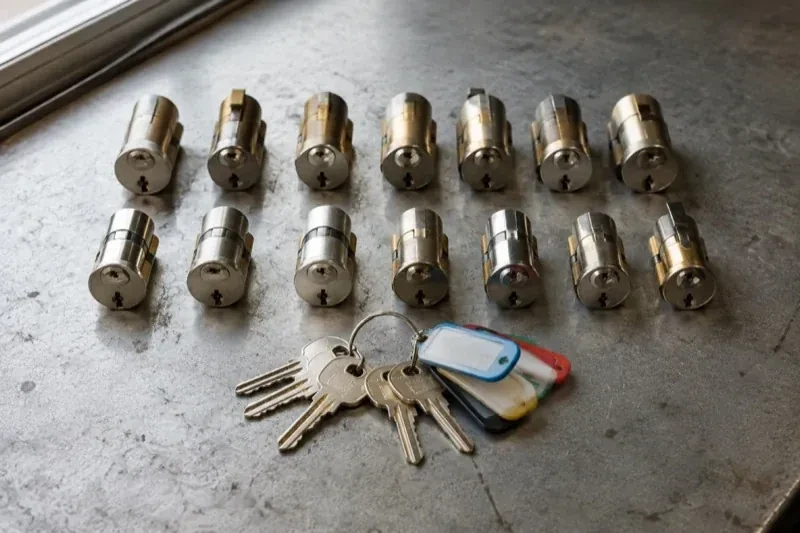
Two rows of lock cylinders on a metal surface with keys and colored key tags in front. — Master Key System Design, Westmount

Commercial · Westmount

Master Key System Design

A new hire at the shop gets handed whatever spare key happens to be in the drawer, and it turns out to open the stockroom, the back office and the safe room all at once. The owner realizes nobody actually decided who should open what.

In plain words

The process behind a master key system runs from conversation to chart. First comes a walk-through of every door and a conversation about who needs to open what, now and as the business grows. Next comes the design itself: grouping doors into change-key sets, deciding where sub-masters belong, and reserving a top-level master for a short list of people. Then the cylinders are pinned, cut and tested individually before any key is handed over. What the owner receives at the end is not just keys but a working hierarchy matched to compatible hardware and documented in a chart they control.

Sound familiar?Westmount

The call
The office key ring has become the org chart. Every manager carries a fistful of cuts, a couple of staff hold copies nobody remembers issuing, and when someone asks which key opens the records room, three different people give three different answers.
NextHow the visit goes

Master Key System Design · Westmount

How the visit goes

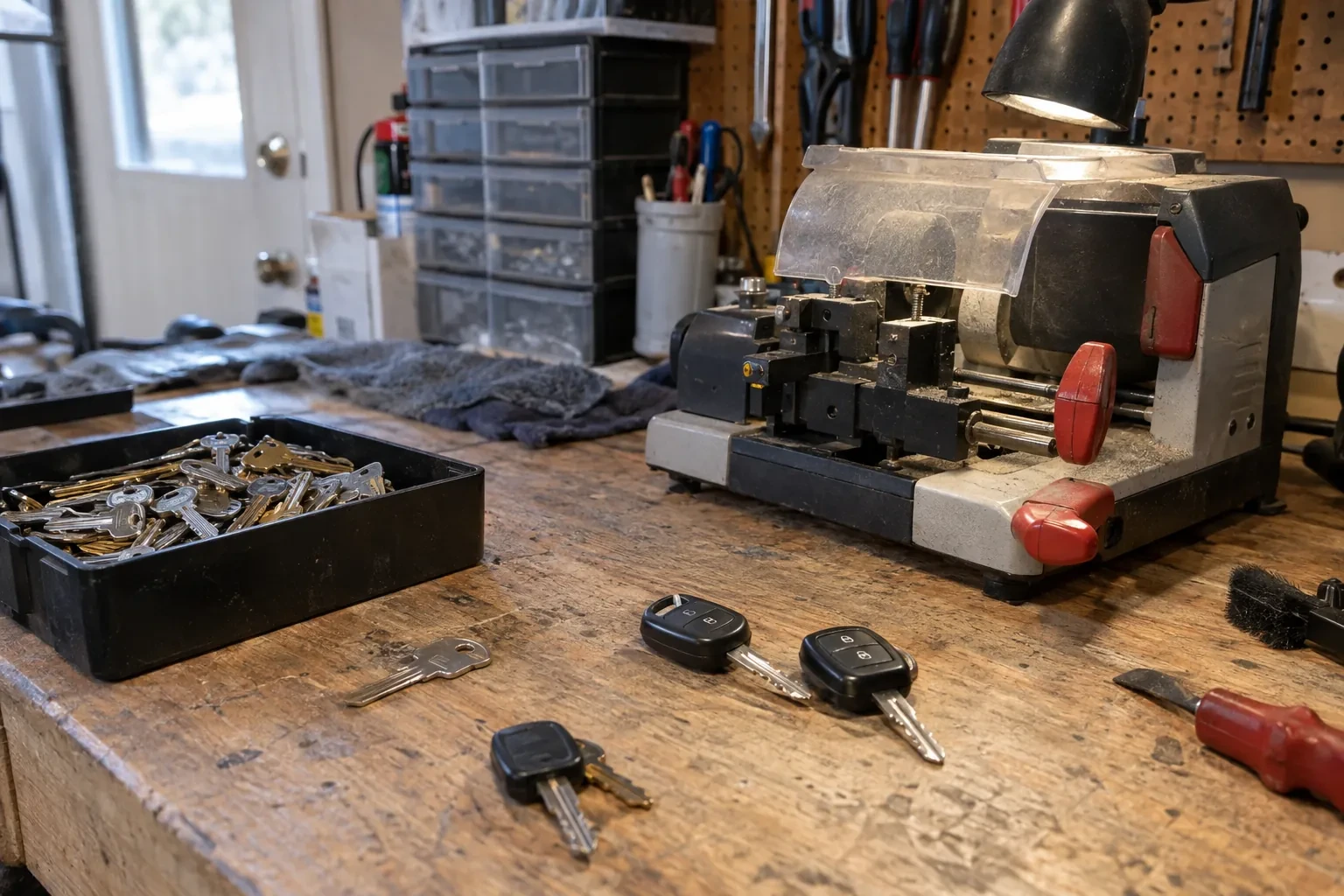
Key-cutting machine with red handles on a worn wooden bench beside a tray of loose keys, key fobs and a screwdriver. — Westmount
  1. Scene 1

    What a shared or multi-tenant building already has in place

    Where the property sits inside a larger building, the check looks at what is already shared: a condominium corporation's own lobby or garage system, a landlord's building-wide master, or another tenant's separate keying. The new hierarchy is designed to sit alongside those systems rather than to cut across them, so a tenant's own suite keeps its own private levels while common areas continue to answer to whoever already manages them. Sorting this out first avoids designing a system that quietly conflicts with access someone else controls.

  2. Scene 2

    Working around a building that is already occupied

    In an occupied property, doors are rekeyed in a planned order rather than all at once, so a department is never left without a working key partway through a shift. Interim arrangements, such as a temporary key for a door being converted to a new level, are agreed in advance and closed out the same visit they are used. This staged approach lets a business keep operating through the change instead of losing access to parts of the building while the new hierarchy is being built.

  3. Scene 3

    Care that keeps the hierarchy intact

    A little routine care keeps a master key system working the way it was designed. Cylinders should get whichever lubricant the cylinder maker actually recommends, since that varies by manufacturer and some rule out graphite while others call for a light oil, and a key that starts needing a wiggle is worth attention before it is forced or breaks off. None of this maintenance touches the pinning itself, so the hierarchy stays exactly as documented on the chart through years of ordinary use.

In the van

  • Restricted or standard key blanks
  • Master pin kits
  • Compatible replacement cylinders
  • Cylinder pinning kit
  • Key cutting machine

What shapes the quoteWestmount Locksmith Co.

Compatibility of existing hardware
Cylinders that can join the new hierarchy without modification keep the project smaller. Hardware that is mismatched, worn or built on an incompatible keyway needs replacing to fit cleanly into the plan, and that replacement hardware is a separate line from the design and pinning work.
Testing scope before handover
Testing every cylinder individually and then testing each master and sub-master across its full group takes time proportional to how many doors and levels exist. A larger hierarchy with more levels to verify against more doors adds to that testing time.
Room reserved for future growth
Building spare capacity into the keying platform so a business can add doors later without a full redesign takes deliberate planning during the design stage. A property with clear expansion plans may choose a platform with more reserved combinations, priced differently from a minimal, current-needs-only design.

FeesSame any hour

Have it ready

Before you call · 0 / 3

(226) 806-0434

Good questions about locks

How is accountability maintained when several people hold different levels of keys?

Through the chart and issuance log rather than memory. Each level is tied to named roles or people, each key is marked to reflect its level rather than the door it opens, and any change of hands is recorded with a signed receipt. That record names every authorized holder for a door, though it can only account for a key that was never copied, loaned or picked up by someone outside that list.

Should I keep spare blanks or unpinned cylinders on hand?

It depends on how the keyway is controlled. With a restricted system, spare blanks are typically held by the locksmith against the authorized record rather than stored loosely on site, since that is what keeps duplication contained. With a standard keyway, keeping a few spare cylinders of the same platform can simplify a later addition, though it is not required.

What happens if a master-level key goes missing?

The current chart shows exactly which doors that level was designed to reach, which for a lost top-level master can mean the whole property rather than one group. Depending on how the key was lost and who else already holds that level, the usual options are repinning the affected cylinders and reissuing keys to the remaining holders; a restricted keyway lowers the odds of an unauthorized copy being cut but is not proof that one has not been made. Without a current chart, the first task is reconstructing that scope.

Westmountinformation

WaterlooOntario

Town
Westmount, Waterloo
In business
33 years
Hours
Open 24/7
Nights, weekends and holidays, same fees
Visits
On-site assessment preferred. Request a visit or call.

2021 census: what it means at the door

Every square is one home in a hundred.

  • 33 in 100 homes · newer homes
  • About 33% of homes in Waterloo were built in 1980 or earlier, according to the 2021 Census.Recent builds often have steel or fibreglass entry doors rather than solid wood. They resist warping and take hardware well, and a locksmith fitting a deadbolt or reinforced strike works with the door's construction so screws bite into something solid.
  • Single-detached houses make up about 49% of homes in Waterloo (2021 Census).Where the housing is mixed, expectations about what can be changed differ. A homeowner in a house decides everything; a condo owner works within house rules on the outer face. The locksmith knows which conversation to have at which door.

Source: Statistics Canada, Census Profile

Open Westmount in Google Maps

On-site assessment

Request a visit.

A new hire at the shop gets handed whatever spare key happens to be in the drawer, and it turns out to open the stockroom, the back office and the safe room all at once.

(226) 806-0434, open 24/7.